

REST DIDN’T FIX IT. LOAD WILL .
A self-guided rehabilitation program for people dealing with patellofemoral pain.
Built from the same rehabilitation framework used with professional athletes. Adapted so you can follow it on your own.
Patellofemoral Pain
$200
$150 · Kickoff Pricing · Lifetime access. Every phase unlocked from day one.
This is the consumer version of the PFJ Protocol and is designed for patients, not healthcare professionals seeking continuing education.
THE PROBLEM
You already know what's wrong. Rest still didn't fix it.
You've rested it, iced it, done the clamshells and quad sets from PT. Maybe a cortisone shot. Maybe a scan that came back clean. Doesn't matter. It still hurts on stairs, in a squat, or playing basketball.
Rest doesn't build capacity. It just delays the moment your knee has to handle load again, and it comes back just as sore.
Your knee doesn't need protecting. It needs to get strong enough to stop complaining.
Are You a Physical Therapist?
Looking for the clinician version instead?
Q1 2027 Launch • Early registrants receive first access
CEUs
Clinical reasoning
PFJ PROTOCOL FOR CLINICIANS includes:
Research reviews
Differential diagnosis
Advanced programming
Case studies
Early Registration: $300 (Regularly $550)
Who built this
-

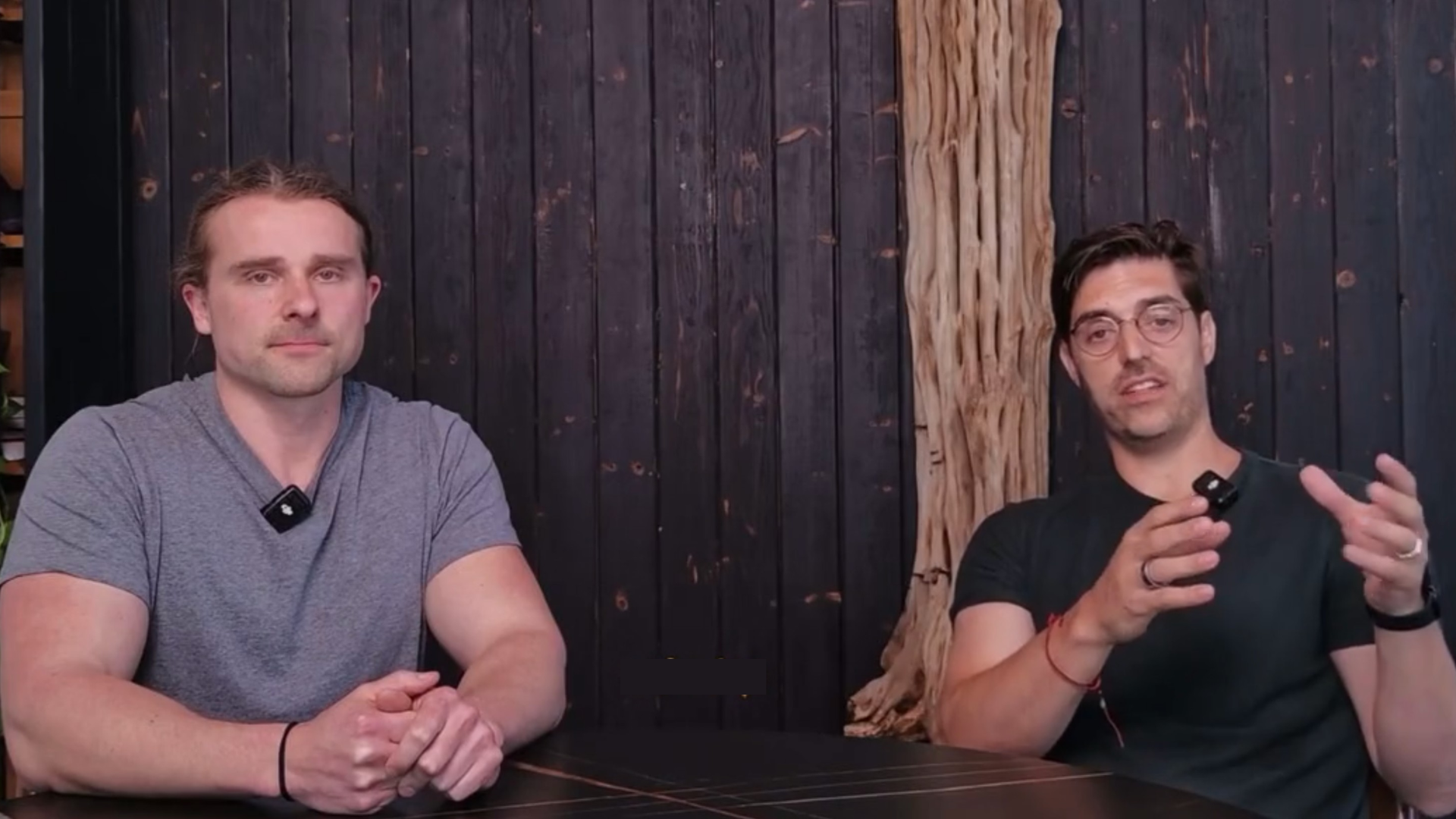
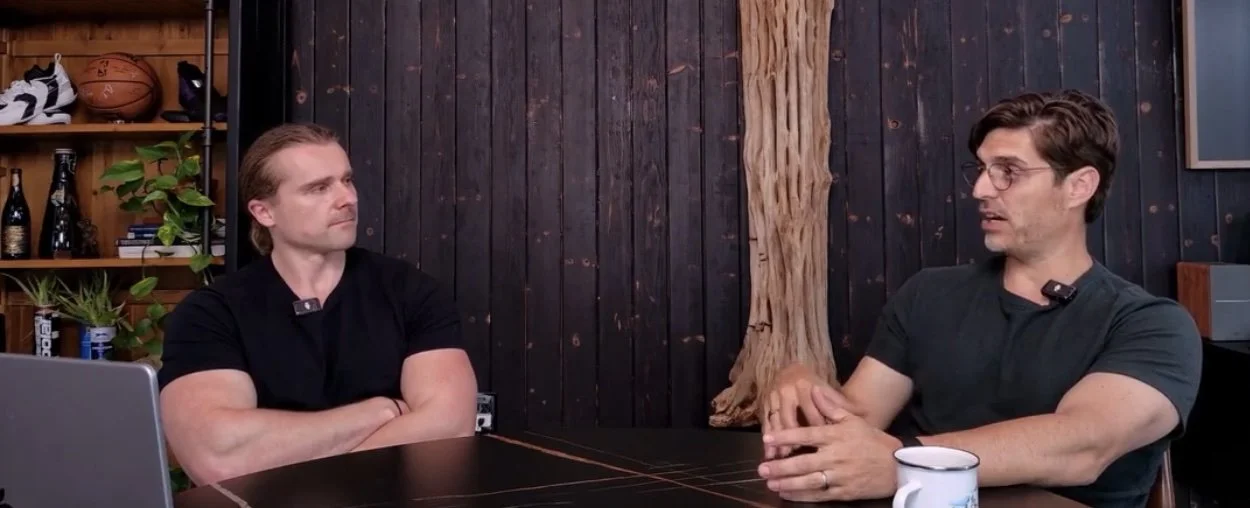
Dr. Jess Elis, PT, DPT, PhD has spent more than 17 years helping athletes recover from knee injuries and return to the sports they love. After leading medical and performance departments in the NBA, he built this program around one belief: your knee doesn't get better by avoiding load—it gets better by learning how to handle it.
The same principles trusted in professional sports have been translated into a step-by-step system that anyone can follow, helping you build confidence, restore capacity, and get back to training without guessing what to do next.
-

Jake Tuura, MS, CSCS, is a strength and conditioning coach and educator specializing in tendon rehabilitation, athletic performance, and vertical jump development. With experience as a collegiate strength coach and years spent working with athletes recovering from patellar and Achilles tendon injuries, Jake has become a leading voice in evidence-informed tendon rehabilitation. Through his coaching, educational content, and the Jacked Athlete Podcast, he helps athletes and clinicians bridge the gap between tendon science and practical performance.
THE SYSTEM
Built the way we return players to the court
This is a graded loading system, not a generic training routine, adapted so you can run it entirely on your own.
THE PFJ BUDGET
01
02
THE FUNCTIONAL SCREEN
SIGNAL WEEKS
BERNOULLI MOVEMENT PREP
A custom screen that measures your knee capacity and where you should start in the protocol. Everyone has a different starting point and the protocol is built to find it.
Every session has a load limit. You train inside it instead of avoiding movement altogether. This leads to progressive overload.
04
03
The prep sequence that opens every session and gets the knee ready to load. Same as we use with athletes before high-output training.
Green, yellow, red weeks. The model looks at the knee responsiveness from a weekly lens, not a daily.
THE PROTOCOL
Three phases. One direction.
Each phase builds directly on the last. You move forward when your knee is ready, not on a fixed calendar.
Phase 01
Capacity
Calm the joint down and build a base it can load on top of. Less protecting it, more re-exposing it to load it can handle.
Phase 02
Power
Strength
Build real strength through the muscles that support the joint. Load goes up as your signals allow it.
Phase 03
Prepare the knee for the demands you actually care about: running, jumping, cutting, or taking stairs two at a time.
WHAT’S INSIDE
One Program. Every Phase Included.
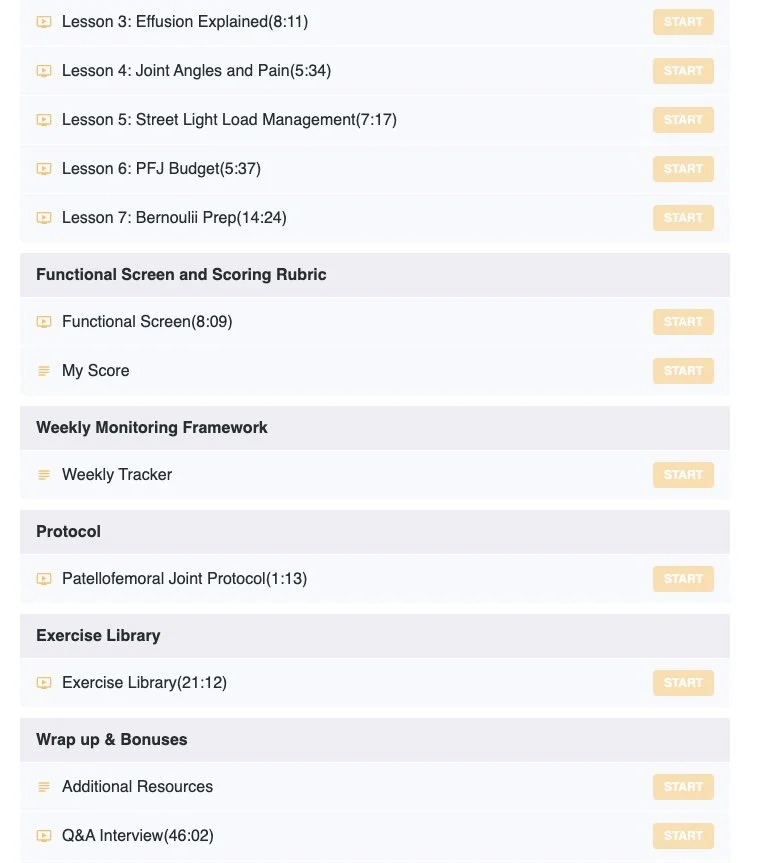
40+ videos, organized by phase. The reasoning and the execution.

The full written program: starting loads, progression rules, phase by phase.
A flare protocol for the weeks your knee doesn't cooperate.
A starting self-assessment that places you in the right phase from day one.
Daily and weekly tracking tools built on the same monitoring system used with professional athletes.
Lifetime access, with every phase unlocked from the day you start.
IS THIS FOR YOU
Built for this knee pain, not every knee pain

THIS IS A FIT IF
Your knee reacts to stairs, squatting, kneeling, running, or sitting for long periods
You've tried rest, generic exercises, tendon loading strategies or stretching, and the pain came back
You want a plan you can run at home or in the gym, without a clinician watching every session
You're aiming to get back to squatting, running, or your sport, not just get through the day
SEE A PHYSICIAN FIRST IF
You haven't been evaluated yet and something feels seriously wrong
Your knee locks, gives way, or buckles without warning
You've had a recent injury, surgery, or trauma to the knee
You have significant swelling with no clear cause
This program is built to restore your knee's capacity to handle load. It doesn't replace a medical evaluation, and completing it isn't a return-to-sport clearance.
QUESTIONS
-
This version was built for individuals managing their own patellofemoral pain, not clinicians looking for continuing education or advanced clinical instruction.
If you are a PT or other healthcare or performance professional looking for research reviews, differential diagnosis, advanced programming, case studies, and CEUs, the PFJ Protocol for Clinicians is the appropriate course.
-
Patellofemoral pain can look very different from person to person, which is why everyone does not start at the same place. The protocol begins with a functional self-assessment that helps you identify the appropriate starting point based on your current symptoms and capacity. From there, specific progression criteria help guide when you are ready to move forward.
The goal is not to find a completely pain-free starting point. It is to find an amount of load your knee can handle now, then progressively build its capacity from there.
-
A flare does not automatically mean you have failed or need to start over. The protocol includes symptom-monitoring tools and a flare strategy that help you decide when to continue, hold, or temporarily reduce the training demand. The program looks at how your knee responds over time rather than overreacting to one difficult session or one bad day.
-
Progressive overload is built into the protocol from the beginning. As your knee demonstrates that it can tolerate more, the demands of training increase across the phases.
Progression is not based simply on finishing a certain number of weeks. Your symptoms, weekly response, functional KPIs, and current capacity help determine whether you advance, hold, or temporarily reduce load. That is the difference between following a collection of knee exercises and progressing through a rehabilitation system.
-
The knee is the primary focus, but the program is not knee-exclusive. Exercises throughout the protocol also challenge the hip, foot and ankle, and other parts of the lower extremity that contribute to how you absorb and produce force.
What the program does not try to do is "fix your entire kinetic chain." Individual limitations at the hip, foot, ankle, or trunk can vary considerably and are better addressed through an individualized assessment. The protocol focuses on the components that are most consistently important for building patellofemoral capacity.
Before you start
-
Most training sessions take about 30 to 45 minutes, typically three to four times per week. Your exact pace will depend on your starting point and how your knee responds to loading. The program is designed to fit into normal training and life without requiring daily supervised rehabilitation.
-
A free video can give you exercises. The PFJ Protocol gives you a system for deciding what to do with them: where to start, how much to load, what to monitor, when to progress, and what to change if your knee becomes more reactive.
The value is not simply having more exercises. It is having a structured process that reduces the guesswork between "my knee hurts" and "I am ready to do more."
-
Not necessarily. Many people with patellofemoral pain can begin a progressive rehabilitation program without advanced imaging, particularly when the presentation has already been evaluated and there has not been a recent traumatic injury.
If you have significant unexplained swelling, locking, repeated giving way, a recent injury or surgery, or symptoms that have not been medically evaluated and concern you, get assessed by a qualified healthcare professional before starting.
-
It may. Prior physical therapy can look very different from person to person. Some programs focus primarily on reducing symptoms, while others progress all the way back toward higher-level strength, running, jumping, or sport demands.
The PFJ Protocol is built around progressive loading, clear progression criteria, and monitoring how your knee responds as its capacity increases. If your previous rehabilitation never progressed to the demands you ultimately wanted to tolerate, this may provide a more structured next step.
-
A diagnosis of arthritis or cartilage change does not automatically mean loading should be avoided. Exercise and progressive strengthening are commonly used to improve function and tolerance in people with knee osteoarthritis, but the appropriate plan can vary based on your symptoms, medical history, and severity of the condition.
If you have a diagnosed joint condition, significant swelling, or uncertainty about whether this program is appropriate for you, check with your physician or physical therapist before beginning.
-
The PFJ Protocol is designed to be self-guided, so individual coaching, exercise-form review, and troubleshooting of your specific presentation are not included with the program.
Instead, you will have progression criteria, symptom-monitoring tools, written programming, and educational videos designed to help you make decisions throughout the process - not simply follow exercises. If you need individualized evaluation or advice for your specific situation, a separate one-on-one consultation or local clinician may be a better fit.
Get back to training without your knee stopping you.
$200
$150 · Kickoff Pricing · Lifetime access. Every phase unlocked from day one.
Built for physical therapists, athletic trainers, chiropractors, physicians, and strength professionals who want to improve their evaluation and rehabilitation of patellofemoral pain.
LOOKING FOR THE CLINICIAN COURSE?
THE PFJ PROTOCOL FOR CLINICIANS
Early Registration: $300
(Regularly $550)
The Patellofemoral Joint Protocol is educational content and does not replace individualized medical care. If you have any of the symptoms listed above, see a physician or physical therapist before beginning this program.